
The Power of Longitudinal Health Data at Scale
Why consistency, time and governance matter more than headline volume
Key takeaways
- Large datasets are valuable only when measurement, provenance and governance are sufficiently consistent.
- Longitudinal records answer different questions from large collections of isolated measurements.
- Scale should strengthen evidence and benchmarking - not be used as a substitute for validation.
More data is not automatically better data
A dataset containing millions of measurements can reveal distributions, variation and patterns that a small study cannot see. But volume cannot repair inconsistent protocols, unclear provenance, biased sampling or poor governance. The value of scale depends on knowing how measurements were collected, whether devices and workflows are comparable and what population the data represents.
Why longitudinal data is different
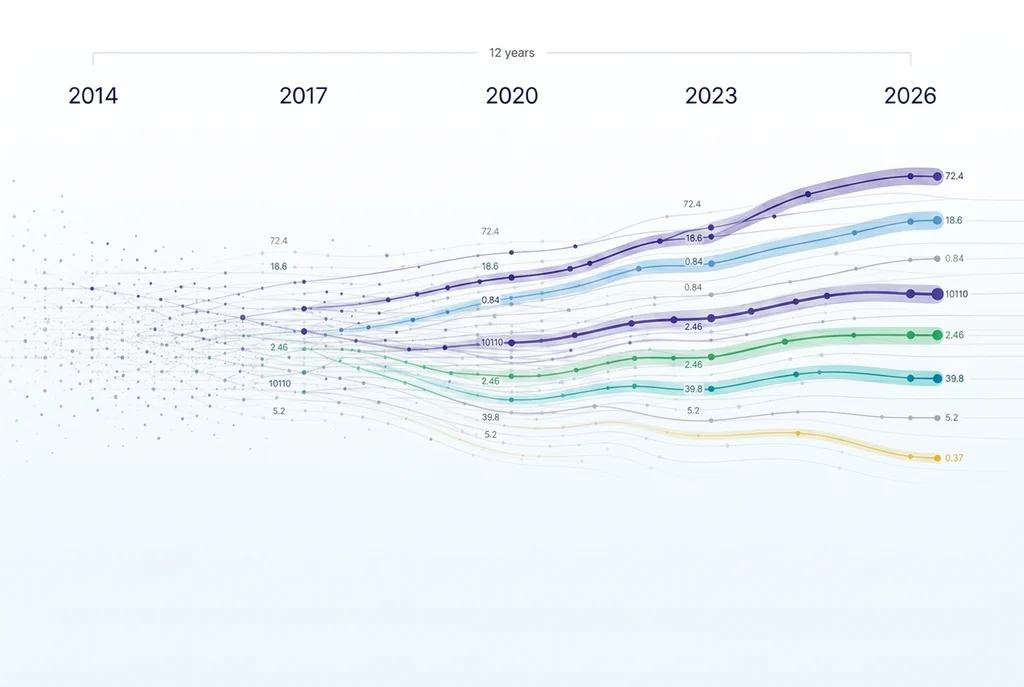
Cross-sectional data compares people at a point in time. Longitudinal data follows change within the same individual or programme. It can show direction, persistence, response to intervention and the difference between normal fluctuation and a meaningful trend.
Repeated records are therefore particularly relevant to weight management, healthy ageing, engagement and programme evaluation. They help answer not only “Where are people now?” but “What is changing, for whom, and after what intervention?”
Benchmarking responsibly
Large datasets can support comparison with relevant cohorts, but a benchmark must be transparent. Age, sex, setting, geography, device, participation bias and measurement frequency can all influence the result. A percentile should describe the reference population and should not be presented as a diagnosis or guarantee of future health.
From scale to intelligence
Across healthcare, workplace wellbeing, fitness, research and public-health settings, boditrax has built a substantial real-world measurement base. Its value is not simply its size. The opportunity is to connect consistent measurements into carefully governed longitudinal records, relevant benchmarks, programme evidence and population-level understanding.
That requires continued investment in data quality, standardisation, consent, security, validation and explainability. IDUNN is the intelligence layer intended to help identify patterns, benchmark change and support decisions - not to diagnose or replace professional judgement. The objective is not to make the largest claim. It is to make a useful, reliable and defensible one.
Conclusion
Scale creates opportunity, not certainty. The defensible value lies in consistent measurement, longitudinal context, transparent governance and intelligence that helps individuals, practitioners and organisations make better-informed decisions.
Explore how boditrax connects measurement, longitudinal records and population intelligence. Find out more
Please note: This article is for general educational purposes and does not replace professional medical advice. boditrax supports assessment and monitoring; it does not diagnose disease.
References
- Benchimol EI et al. The REporting of studies Conducted using Observational Routinely-collected health Data (RECORD) statement. PLoS Medicine. 2015;12:e1001885.
- Hernán MA, Robins JM. Causal Inference: What If. Boca Raton: Chapman & Hall/CRC; 2020.
- Kyle UG et al. Bioelectrical impedance analysis - part I: review of principles and methods. Clinical Nutrition. 2004;23:1226–1243.
Request a Demonstration
Deployments, integrations, programmes and partnerships. Tell us what you are trying to change and we will show you how the platform supports it.
- Platform walkthrough
- Real-world deployment examples